Record label obtains interim injunction against former distributor and sub-publisher
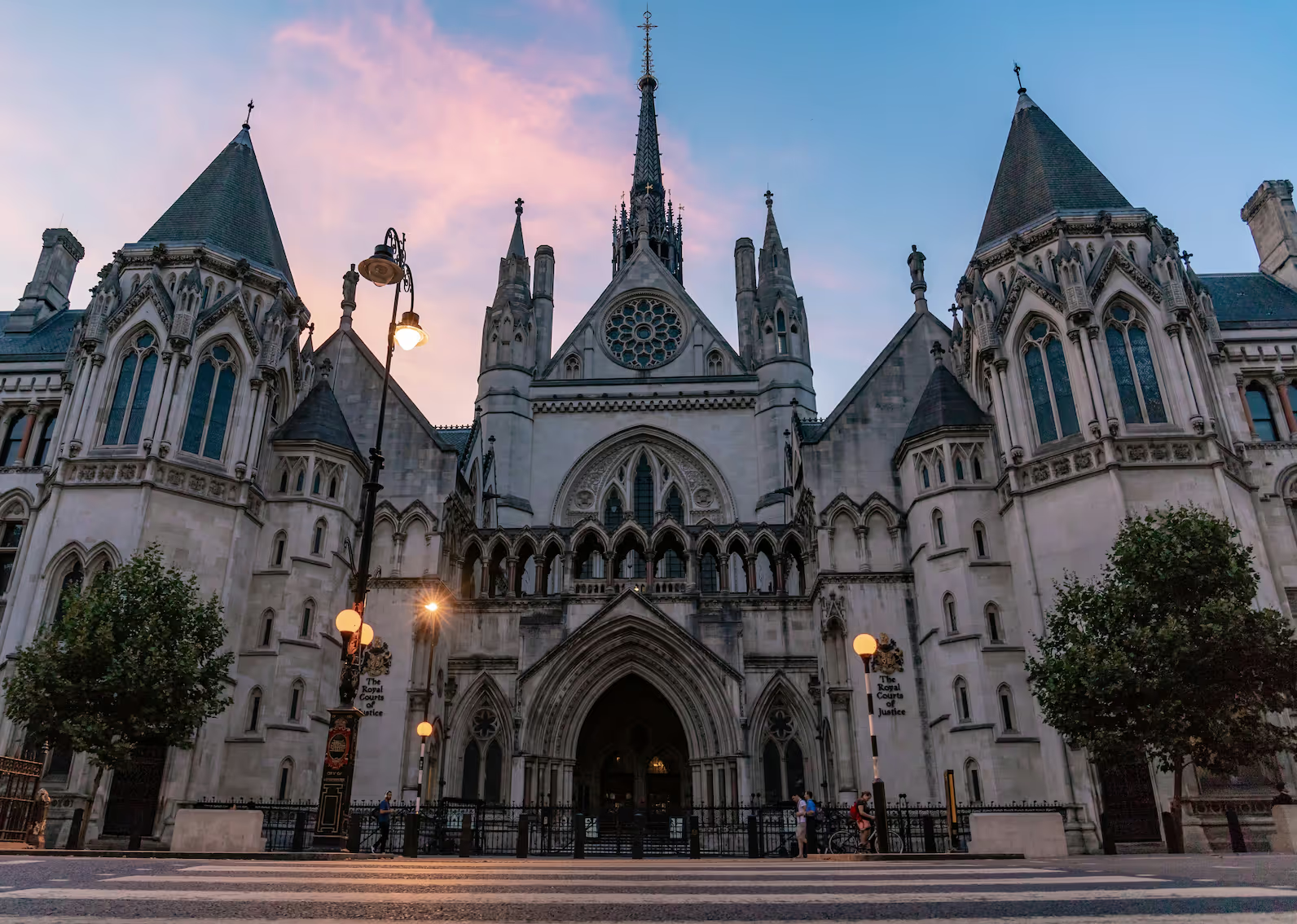
The High Court has ruled on an interim injunction application brought by the record label and music publisher NoCopyrightSounds Limited (NCS) against its former distributor, AEI Music Limited, and its former sub-publisher, Featherstone Music, over exploitation of NCS’s extensive catalogue.[1]
The court granted the interim injunction, finding that NCS succeeded on both the “adequacy of damages” and “balance of convenience” limbs of the American Cyanamid test.[2] AEI and Featherstone were therefore prevented until trial from continuing to distribute or otherwise exploiting NCS’s music, or from carrying on any business by reference to NCS’s name.
Background
The claimant, NCS, is a specialist record label and publisher, which also operates social media channels under the name “NoCopyrightSounds” and “NCS”. NCS has an innovative business model, allowing content creators on certain platforms, such as YouTube, to use the rights in its music catalogue on a royalty-free basis, while promoting the tracks commercially in other ways. The defendants, AEI and its affiliate Featherstone, were NCS’s former distributor and sub-publisher respectively.
Since 2014, the parties had entered into various agreements, under which AEI and Featherstone were to account to NCS in relation to certain percentages of the proceeds from a range of types of exploitation of the catalogue. During 2024, NCS learnt of the existence of a significant debt owed to it by AEI, which had arisen as a result of AEI’s failure to account properly for sums contractually owed to NCS. By May 2025, AEI confirmed that the debt owed to NCS had grown to £4.1 million, and that it could not afford to pay more than £250,000 without risk of insolvency.
In September 2025, NCS terminated its agreements with AEI for unremedied material breach. NCS also terminated its agreement with Featherstone in September 2025, after giving a reasonable notice period.
The defendants, however, disputed the terminations. AEI argued that a separate Heads of Agreement (HOA) had in fact replaced the agreements that NCS purported to terminate, and that any licence granted under the HOA would not expire until July 2026. In the alternative, AEI argued that there was no material breach of the agreements when NCS served breach notices in July 2025 relating to the debt. Featherstone similarly relied on the HOA (despite not being a party to it) and, in the alternative, argued that the termination notice given by NCS in July 2025 was invalid or unreasonable. As a result, the defendants continued to exploit NCS’s catalogue and to collect proceeds of such exploitation (or attempted to do so) after September 2025 (when NCS had terminated the agreements).
NCS issued a High Court claim against AEI and Featherstone in November 2025, and almost immediately made an interim injunction application in those proceedings to prevent AEI and Featherstone from continuing to exploit its catalogue, or from carrying on any business by reference to its name. The application was heard in the High Court before His Honour Judge Jarman KC on 21 January 2026.
Decision
No arguable defence
In its submissions, NCS argued that AEI and Featherstone had no arguable defence on the issue of termination, and that the interim injunction should be granted on that basis. The cases of Manchester Corp v Connolly[3], Patel v Smith Ltd[4] and Official Custodian for Charities v Mackey[5] were cited in support of the submission that the American Cyanamid principles need not be applied where there is no arguable defence to a claimant’s claim.
That argument was disputed as a matter of law by the defendants, who argued that the principle should be limited to cases where the rights in question had already been ruled on. HHJ Jarman KC rejected the defendants’ arguments, concluding that an interim injunction could be granted in the circumstances of the case if there were indeed no arguable defence, commenting that:
“In my judgment, the principles set out above are not so limited, although of course a previous pronouncement of the rights in question may be an important factor. As a matter of principle, I cannot see why a claimant who faces no arguable defence should wait until trial and inevitable vindication and should not be awarded interim relief to enforce their rights in the meantime. The question in the present case is whether there is an arguable defence.”
NCS argued that there was no arguable defence, primarily because the HOA could not have replaced the agreements in governing the commercial relationship between the parties. NCS submitted that the plain wording of the HOA itself, the commercial context of its terms and the parties’ conduct before and after the agreement was entered into, all unambiguously supported that conclusion. AEI and Featherstone, by contrast, argued that the contractual position between the parties was “messy”, and that it would be inappropriate for the court to make a determination on contractual issues during a “mini trial” before disclosure had been completed.
The judge ultimately agreed with the defendants on this issue, concluding that, as strong as the case of NCS might be on the relevant contractual terms relating to termination, it fell short of showing that there was no arguable defence to that case, and that it was not appropriate for the court to decide those issues “in a mini trial without disclosure and evidence”.
American Cyanamid principles
The judge therefore applied the American Cyanamid principles, which were summarised in Lord Hoffmann’s judgment in Olint[6], noting that:
- If damages would be an adequate remedy for the claimant, there are no grounds for interfering with the defendant’s freedom of action by granting an injunction.
- Likewise, an injunction should ordinarily be granted if there is a serious issue to be tried and the claimant could be prejudiced by the acts or omissions of the defendant pending trial and the cross-undertaking in damages would provide the defendant with an adequate remedy if it turns out that an injunction should not have been granted.
The judge’s ruling addressed each limb of the test in turn.
1. Is there a serious issue to be tried?
It was not in dispute that there were serious issues to be tried in this case, so the second limb of the test – whether damages would be an adequate remedy – was applied.
2. Would damages be an adequate remedy?
The judge was satisfied that damages were unlikely to be an adequate remedy for NCS if an interim injunction were not granted and NCS ultimately succeeded at trial.
- First, the damage to NCS’s rights from the defendants’ continued exploitation of NCS’s intellectual property was likely to be more than just financial. The rights in question were property rights in nature, and NCS had submitted evidence that new or potential licensees had expressed concern about using the rights during the course of the litigation.
- Secondly, even if the loss might be purely financial, the evidence before the court showed that it was unlikely that AEI and Featherstone would be able to compensate NCS for such loss. There was a substantial sum already owed toNCS that the defendants were unable to repay.
By contrast, the judge was satisfied that damages would be an adequate remedy for AEI and Featherstone if an injunction were granted and the defendants ultimately succeeded at trial. By the time of the interim injunction hearing in January 2026, AEI and Featherstone had accepted that their licence to exploit NCS’s rights (on their case, under the HOA) would expire by the end of July 2026 in any event. It followed that their losses would be confined to approximately six months of lost earnings under the relevant agreements. The judge accepted that, even if that figure exceeded the estimates provided by the parties, NCS could either set that off against the much larger debt owed to it by AEI or pay it from its cash reserves.
Accordingly, HHJ Jarman KC concluded that the interim injunction should be granted on the basis that damages would not be an adequate remedy for NCS, while they would be for AEI and Featherstone. Nevertheless, the judge also considered where the balance of convenience lay, in case he was wrong about adequacy of damages.
3. Where did the balance of convenience lie?
The judge also found that the balance of convenience lay in NCS’s favour as:
- NCS’s case was the stronger;
- the potential harm to NCS was greater, given the parties’ respective financial positions; and
- while AEI and Featherstone argued that the status quo should be allowed to continue, their licences would expire in July 2026 (on their own case) in any event.
Accordingly, NCS succeeded on both the “adequacy of damages” and “balance of convenience” limbs of the American Cyanamid test, and the High Court granted the interim injunction.
Comment
The judgment sets out a helpful analysis of the function of arguments around merits in interim injunction applications.
- First, it is useful in demonstrating that the court need not apply the American Cyanamid principles at all, if a claimant can successfully demonstrate that there is no arguable defence. Yet the courts will be wary to avoid conducting a “mini trial” on the merits of a claim, especially if the issue in question might be fact-sensitive.
- Secondly, it is useful in demonstrating that, even if there is not enough evidence for the court to find that there is no arguable defence, the court may still take the merits of the parties’ respective positions into account when considering where the balance of convenience lies.
The decision also highlights the importance of carefully considering, when bringing or opposing an interim injunction application, whether damages would be a sufficient remedy. As noted in Olint, if damages would be an adequate remedy for the applicant, an interim injunction would be refused on that basis. Conversely, if the court is satisfied that damages would not be an adequate remedy for the applicant, but would be for a respondent, then an interim injunction would usually be granted. Only if there is doubt about the adequacy of damages will the court ordinarily need to consider more broadly where the balance of convenience lies.
Article written for Entertainment Law Review.


.png)

.jpg)